What Google’s Agentic Commerce Push Means for Your Shopping Campaigns
Google is rebuilding Shopping around AI. Here’s what’s changing, what it means for your feed strategy, and why the merchants who act now will win.
Google recently shared its “Agentic Commerce Foundations” guidance with EMEA partners, a roadmap for how Shopping experiences are evolving as AI takes a more active role in product discovery and purchase decisions. The document outlines what merchants need to do today, and signals where Google is heading next.
Here’s what matters for e-commerce merchants running Shopping campaigns in Europe and what you should do about it.
The shift: from keyword matching to AI matching
Traditional Google Shopping works on keyword-to-product matching. You bid on queries, your product feed gets matched, shoppers click.
That model isn’t disappearing, but it’s being layered with something new. Google’s AI Mode (launched in January 2026) interprets conversational, longer-form queries and matches them against product attributes. Shoppers are typing queries that are 2-3x longer than traditional searches. Instead of “running shoes men”, they’re searching things like “lightweight running shoes for flat feet that work on trails and pavement.”
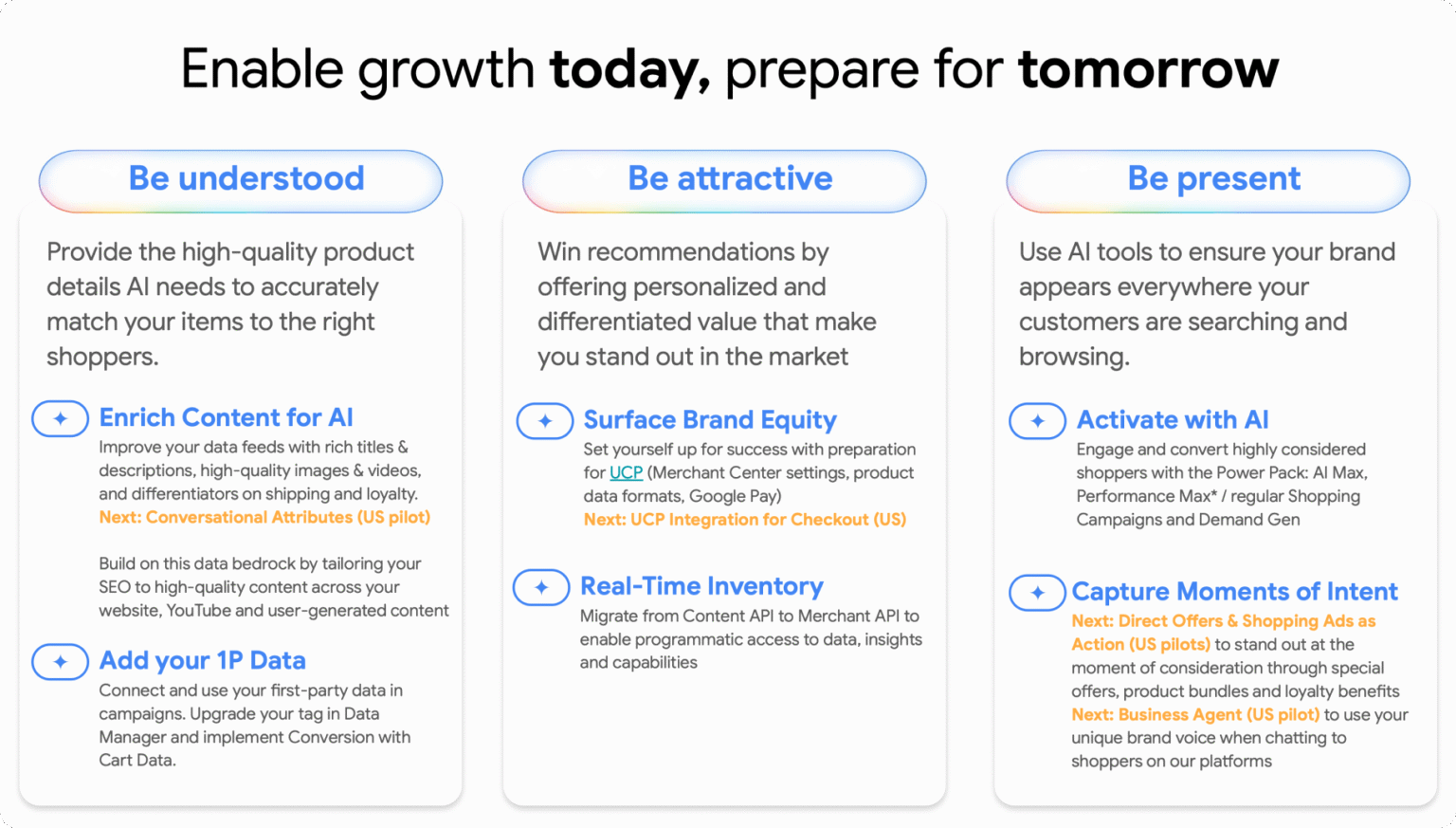
Google’s Agentic Commerce framework organises this shift around three pillars: Be understood, Be attractive, and Be present. Underneath, the message is consistent: product data quality is now the single biggest lever for Shopping performance.
“Be understood”: your feed is your foundation
Google’s first pillar is discoverability, ensuring AI systems accurately match your products to the right shoppers. Their guidance is specific:
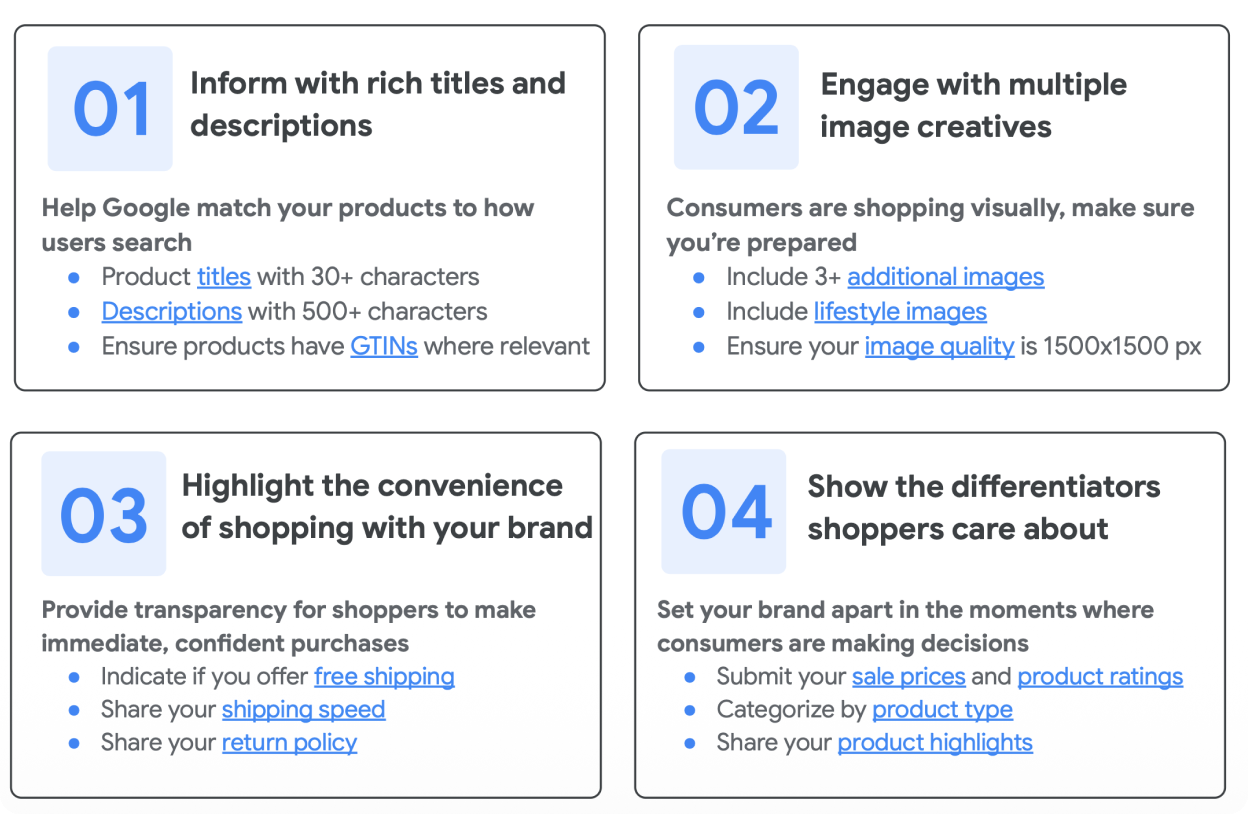
→ Product titles with 30+ characters, rich in context (not keyword-stuffed)
→ Descriptions with 500+ characters that answer the questions a shop assistant would answer
→ 3+ additional images per product, including lifestyle images, at 1500x1500px minimum
→ GTINs on every product where relevant
→ Shipping speed, return policies, and free shipping indicators submitted in your feed
This isn’t new advice in isolation, but the reason it matters has fundamentally changed. In a keyword-matching world, a sparse title could still win an auction if your bid was high enough. In an AI-matching world, sparse data means you simply won’t be considered. The AI can’t recommend what it doesn’t understand.
For merchants working with a CSS partner like Shoparize, this is where feed optimisation becomes critical. Our Managed Ads service includes exactly this: title structure, GTIN coverage, category segmentation, and competitive pricing checks. The merchants whose feeds are already well-structured will gain the most from the AI shift. The ones with thin product data will quietly lose visibility.
“Be attractive”: brand equity and real-time data
Google’s second pillar focuses on standing out once you’ve been matched. The guidance covers:
→ Submitting sale prices and product ratings
→ Categorising by product type and sharing product highlights
→ Preparing for Universal Commerce Protocol (UCP), currently a US pilot, but signals what’s coming
→ Migrating from Content API to Merchant API for real-time inventory access
The key takeaway: Google is moving toward a world where it takes a more proactive role in product recommendation. And recommendation engines favour merchants who provide richer, more differentiated data. Competitive pricing, loyalty differentiators, fast shipping, transparent return policies, these become ranking signals, not just nice-to-haves.
For merchants running multi-CSS setups, this reinforces why working with partners who actively manage your feed matters more than ever. A CSS partner that simply submits your existing feed as-is won’t capture the gains from enriched product data.
“Be present”: activating with AI campaigns
Google’s third pillar focuses on campaign strategy, using AI-powered campaign formats to reach shoppers across discovery surfaces. The guidance highlights what they call the “Power Pack”: AI Max, Performance Max, regular Shopping campaigns, and Demand Gen, used together.
Importantly, a footnote in the document confirms that Performance Max campaigns can be used with any CSS in CSS Program countries. This matters because some merchants still believe that working with a CSS partner limits their access to newer Google ad formats. It doesn’t. Your CSS partner’s campaigns appear on general search results and any surfaces the CSS has opted into.
What’s forward-looking: Google is piloting “Direct Offers & Shopping Ads as Action” (currently US-only), standing out at the moment of consideration through special offers, bundles, and loyalty benefits. They’re also piloting a “Business Agent” that lets merchants use their unique brand voice when chatting to shoppers on Google’s platforms. Neither is live in Europe yet, but both signal the direction.
What this means for CSS strategy
If you’re an e-commerce merchant running Shopping campaigns in Europe, there are a few practical implications:
Feed quality is no longer optional. The bar has risen from “good enough to win auctions” to “good enough for AI to recommend you.” This means investing in attribute coverage, descriptive titles, rich descriptions, and complete product data. If you’re working with a CSS partner, ask them what they’re doing about feed enrichment, not just bid management.
Multi-CSS still works and arguably matters more. Google’s auction mechanics haven’t changed: bids are deduplicated at the merchant level, not the CSS level. Adding a CSS partner doesn’t cannibalise your own campaigns. With AI Mode expanding the range of queries your products can match against, the coverage benefit of a multi-CSS setup increases.
CPA models align well with this shift. As AI surfaces evolve and new campaign formats emerge, the uncertainty around which queries and surfaces will drive conversions increases. A pay-per-sale model removes the downside risk of testing into these new formats, you only pay when it converts.
Watch the US pilots. Features like UCP checkout, Business Agent, and Shopping Ads as Action are in the US pilot today. They will likely reach EU markets. The merchants who are already well-prepared on feed quality, real-time inventory, and enriched product data will be first to benefit.
Our take
At Shoparize, we’ve been managing Shopping campaigns on a pay-per-sale basis for over 10 years. We serve 10,000+ merchants across 21 European markets. Feed optimisation has always been part of what we do; it directly impacts the conversions we generate, and since we’re paid on performance, we have every incentive to get it right.
Google’s Agentic Commerce guidance confirms what we’ve been telling merchants: the quality of your product data is becoming the primary driver of Shopping performance. Not just bids. Not just budgets. Data.
If you want to discuss what this means for your campaigns, or if you want to see how a managed, pay-per-sale CSS layer can help you capture the opportunities in this shift, reach out to our team. Ready to get started right now? Start here.