
Introduction
The European Commission has ruled that Google breached the Digital Markets Act by favouring its own Shopping results over comparison services, and ordered it to stop. Google Shopping in the EEA is already changing as a result.
Three years of rejected compliance attempts ended in a formal breach decision
The Commission designated Alphabet a gatekeeper in September 2023, with Google Search as a core platform service, which placed it under an obligation to stop giving its own results a placement advantage. What followed was a slow back-and-forth: Google submitted a compliance report in March 2024; the Commission decided it wasn’t enough and opened a formal investigation; and a year later, in March 2025, it told Google it still hadn’t fixed the problem. After the second rejection, Google presented CSS groups with a separate proposal for Shopping Ads, called "box-to-box".
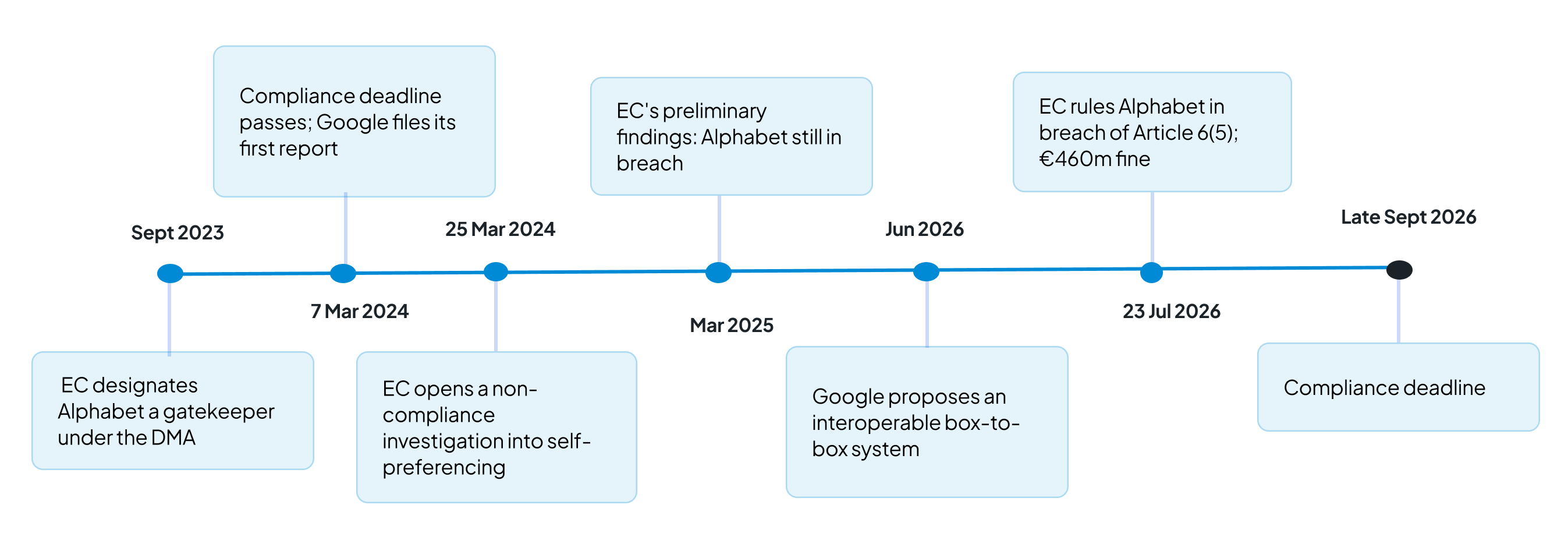
Timeline:
- Sept 2023: EC designates Alphabet a gatekeeper under the DMA
- 7 Mar 2024: Compliance deadline passes; Google files its first report
- 25 Mar 2024: EC opens a non-compliance investigation into self-preferencing
- Mar 2025: EC's preliminary findings: Alphabet still in breach
- Jun 2026: Google proposes an interoperable box-to-box system
- 23 Jul 2026: EC rules Alphabet in breach of Article 6(5); €460m fine, 60-day compliance deadline set
- Late Sept 2026: Compliance deadline
Across the three-year process, the Commission judged that nothing Google changed removed the placement advantage its own results held over rival services. The July decision ended the back-and-forth by formalising non-compliance and setting a deadline.
The Commission found that Google treated its own services better than rivals’
The EC found that Google’s specialised shopping, hotel, transport and sports results relied on its own data feeds rather than standard web crawling, making them distinct services in their own right. Those services received better placement on the results page than comparable third-party offerings could reach.
The ruling carries a €460 million fine; the Search half of an €890 million package was announced the same day, with a 60-day deadline expiring in late September 2026. If Google misses the deadline, it could face periodic penalty payments, capped at 5% of its average daily worldwide turnover under Article 31 of the DMA, for each day of non-compliance.
In response, Google’s organic product carousels are already changing
Google’s answer on the organic side is an accordion: rows for each comparison service, including Google’s own, each pulling listings from that service’s inventory. It's rolling out across the EEA now, replacing Google's organic product carousels.
The early data show the effect. Clicks on CSS product pages have roughly tripled since the rollout began, per Shoparize's internal data across 21 EU markets.
The 60-day compliance window is still open, and the Commission hasn't confirmed whether the new layout complies with Article 6(5). We covered the layout itself in more depth in last week’s post.
The new comparison box could reshape how CSSs compete for Shopping Ads
Under the box-to-box proposal, comparison services would compete for control of the entire product ads unit on a per-search basis, with the winner configuring what appears inside it. It's a more ambitious concept than the organic accordion, giving the winning CSS control of the whole unit. Google designed and proposed it in June 2026, and the Commission has not said whether it would meet Article 6(5). For now, Shopping Ads work as before, and there is no confirmed date for box-to-box, or confirmation that it will happen.
The organic change is rolling out; the paid change is still a proposal
The organic rollout is still new, so most merchants haven't had a chance to test it properly yet.
The paid side is the bigger strategic question, and it's still unresolved. Until it's settled, pay-per-sale models such as Shoparize Managed Ads add Shopping visibility with no media budget at risk.
For your CSS strategy, there are two practical things worth doing now.
- First, check whether your products actually appear in the CSS rows in each of your markets, since the accordion only shows what's in each partner's feed.
- Second, if you currently only work with one CSS, this is a reason to look at working with more than one: each CSS gets its own row in the new layout, so more CSS partners mean more places your products can appear.
On the paid side, there's nothing to change yet, since Shopping Ads haven't moved.
The paid side of the case is still undecided
The Commission hasn't given a timeline for when that changes. If the box-to-box proposal goes ahead in its current form, it will reshape how CSS partners compete for Shopping Ads placement and change how advertisers think about which CSS they work with.
As CSS ourselves, we're tracking this closely and will cover the ads-side proposal in detail, including what CSS partners are pushing back on. We will also look at what the new organic layout means for a multi-CSS strategy once the picture is clearer.