
Introduction
Black Friday is on 27 November this year, but many shoppers are researching the products they want to buy weeks before retailers launch their deals. Most compare products and prices before adding items to their cart. If your prices, feed, and promotions aren't ready until the 27th, you'll miss out on shoppers who are already looking.
In Google's survey of shoppers across six European markets (the UK, Germany, France, Italy, Spain and Poland), only 6% of last year's Black Friday buyers don't expect to participate again this year, but just 13% expect to spend more than they did last year on Black Friday.
Shoppers start planning before November
Knowing the best times when shoppers start researching will help you plan and prepare before they compare offers. In Google's survey of Black Friday buyers across six European markets, almost half (48%) had started considering their most expensive purchase by the end of September, and 64% by the end of October. Only 22% first considered it during the sales themselves.
The money is set aside early too: 84% of last year's Black Friday buyers are already holding a purchase back for November 2026, and 44% of them haven't chosen what to buy yet.
The takeaway for Q4 is simple: don't wait for Black Friday to become visible. Your products, prices, and campaigns should be ready while shoppers are still researching and deciding what to buy.
Get your feed, prices, and promotions ready by mid-October
Because shoppers are researching now, we recommend finishing your feed and setting your Black Friday prices by mid-October.
Your product price, stock, and details should be updated and live by the time shoppers start saving products to their lists. Our Google Shopping feed checklist covers every field to check.
- Check your titles, descriptions, images, GTINs, and availability.
- Make sure your product's material, size, and use are up to date and ready to be found by shoppers' research.
With AI Mode launched across Europe in October 2025, shoppers have been asking longer, more specific questions, and Google says AI Mode searches are about three times as long as traditional ones, so these details matter more.
In Google Merchant Center, you can schedule each sale price with start and end dates, so offers turn on and off automatically.
Mid-October is also the time to share your promotion calendar with whoever runs your campaigns. Have it ready at least two weeks ahead of each campaign. If you pay per sale, that's also the perfect time to agree on your commission rates before click costs rise. If you run your own campaigns, raise budgets gradually through October and step them up before Fake Friday.
For a complete checklist of what to prepare, see our article “Getting ready for Black Friday 2026.”
Decide when your Black Friday starts
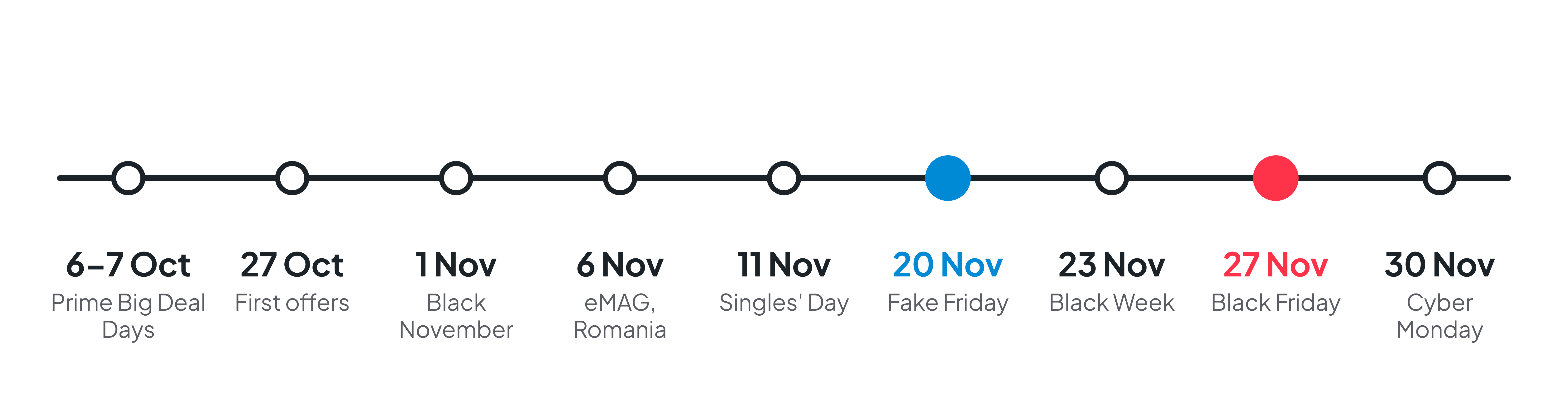
Amazon kicks off the season with Prime Big Deal Days on 6 and 7 October. Calling it Black Friday might not be the most accurate term these days, with many retailers starting their deals in late October or early November.
Black Friday is no longer one day, so merchants need to decide early on when the sales actually start, as this can impact pricing, promotions, and campaign planning.
Across countries, companies started their seasonal sales early, such as MediaMarkt and Saturn in Germany, which launched their first deals in late October. It is also important to notice the changes in Black Friday calendar dates, as they can impact your planning or, at the very least, give you an insight into market trends. A great example is Romania, with a Black Friday on 6 November. For international merchants active there, it can also be a useful first test of the Q4 peak and give an early indication of demand, conversion, pricing, and campaign performance before the bigger peak across other markets
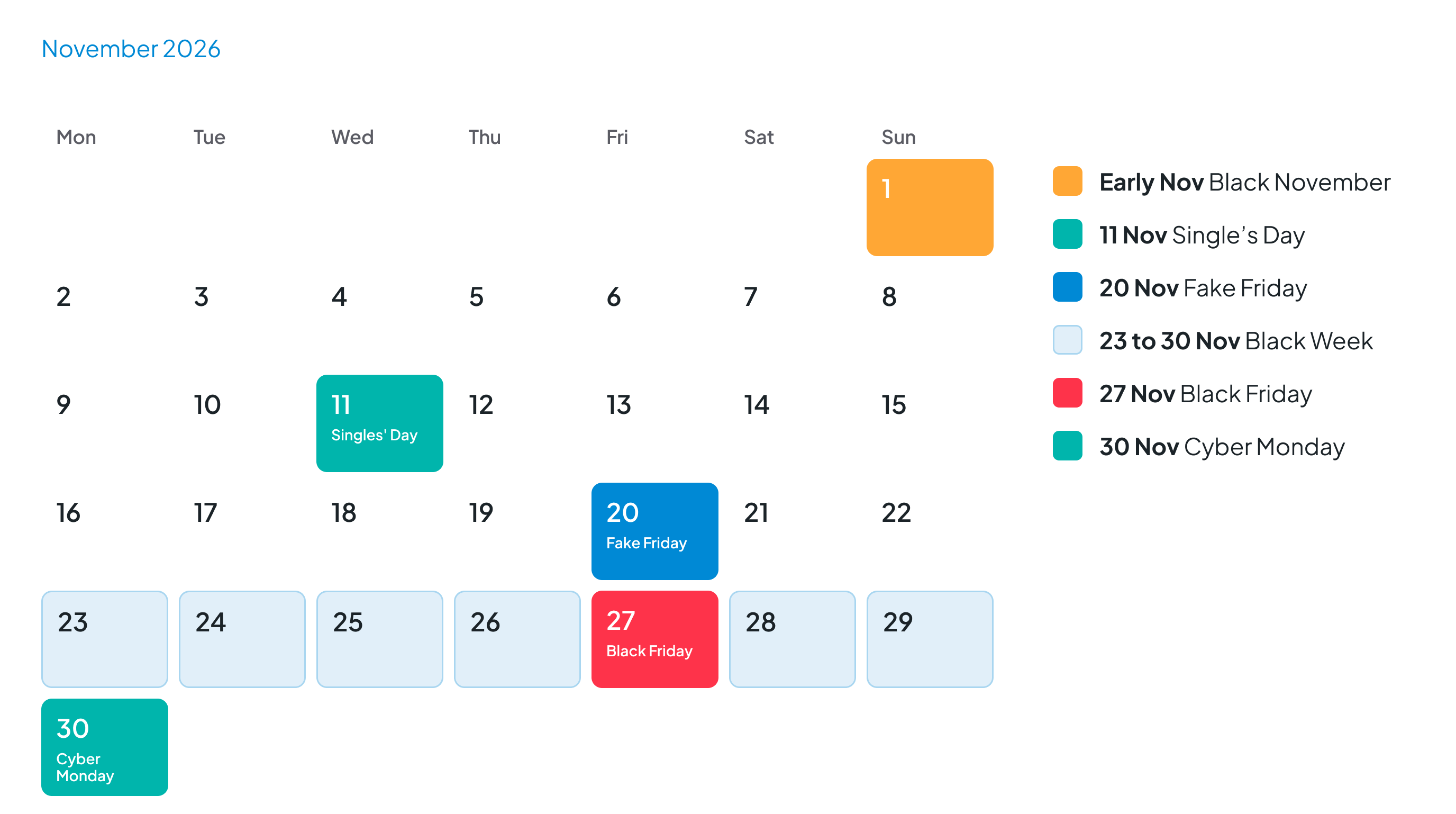
You might also have heard of Fake Friday, the Friday before the actual Black Friday, this year on 20 November. For many retailers, it is time to launch their main Black Friday events. Amazon.de's Black Friday Week, for example, began on 20 November, eight days before Black Friday (Amazon). Shoppers also expect to hear about offers early: 58% want Black Friday messages at least a month before the day, and 82% at least two weeks before (Sinch).
The deciding factor comes down to your goals, as starting early on your deals allows for a longer sales cycle, which brings in more revenue at a lower margin. A shorter one protects your margin. But whatever you do, set your date now, as two major things depend on it:
- Your regular prices. Under European Commission rules, a discount is measured against the lowest price of the previous 30 days, so keep regular prices stable for 30 days before your first offer. That's early October if you start in November and 21 October if you start on Fake Friday.
- Your offer price. In Google's survey, 67% of Black Friday buyers checked whether the price was real before buying. On a comparison surface, your offer sits right next to your competitors', and shoppers can see every price change. If you discount on Fake Friday and then cut the price again on Black Friday, the same shoppers will notice.
Black Week peaks at very different levels across Europe
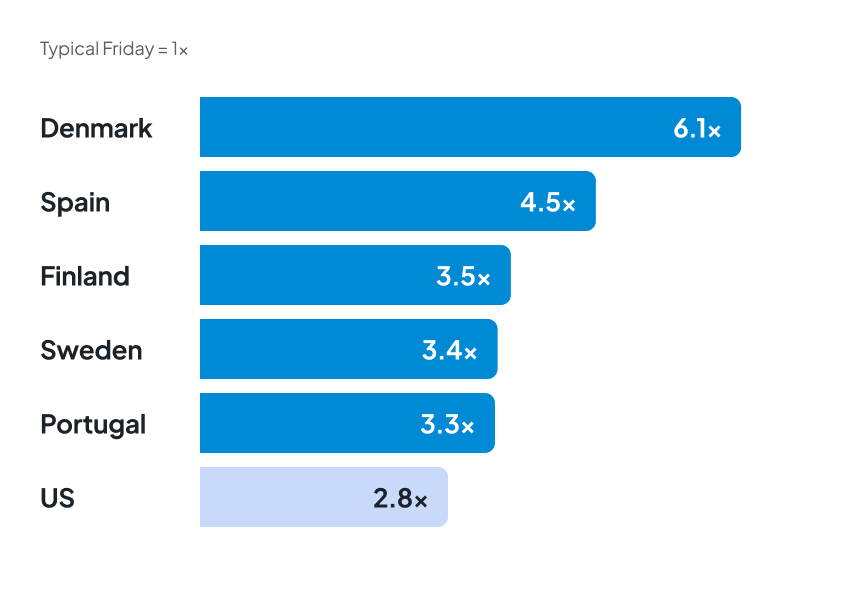
Black Week runs from Monday 23 November through Black Friday on the 27th to Cyber Monday on the 30th, and how sharply sales rise depends on where you sell. Last year, Adyen found that Black Friday transaction volume ranged from 3.3 times that of a typical Friday in Portugal to 6.1 times that of a typical Friday in Denmark, compared with 2.8 times in the US.
Peak hours differed too, from 6 p.m. in the UK and Poland to 9 p.m. in Germany.
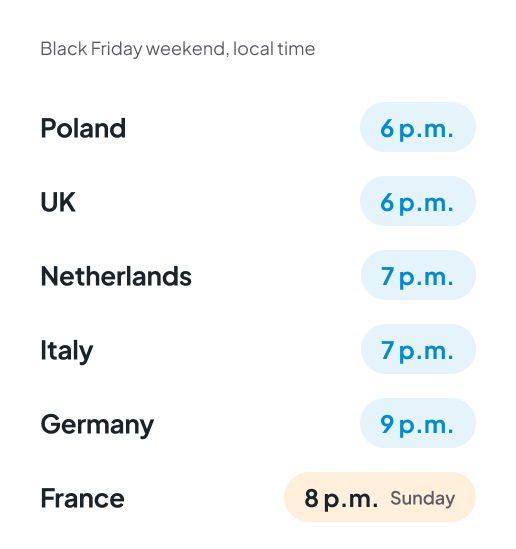
With differing peaks, a single budget plan won't work everywhere. Set your Black Week budgets market by market, based on each market's peak last year, and keep enough budget for the evening peaks.
If you sell in the Benelux or Germany, have your Sinterklaas (5 December) and Nikolaus (6 December) promotions ready before Cyber Monday, as both fall within a week of it. The fourth quarter doesn't end with Cyber Monday. In a few markets there are important local shopping peaks immediately afterwards, so keep in mind to have your planned budget, stock and promotions set beyond Black Friday weekend.
Your Black Friday 2026 calendar at a glance
Here's everything in one place, from now to Cyber Monday.
| Date | What happens | What we recommend |
|---|---|---|
| Now to end of September | The last weeks to set up new campaigns so they're optimised by Cyber Week | Start your feed audit and plan your Black Friday prices |
| 6 and 7 October | Amazon Prime Big Deal Days open the season in 13 European markets | Check your prices against the first big deals of the season |
| Mid-October | Shoppers are researching and comparing products | Finish your feed audit, set your Black Friday prices and promotion calendar, confirm stock for your top sellers, and agree a higher commission or plan your budget increases per market |
| 21 October | 30 days before Fake Friday offers | If your offers start on Fake Friday, keep your regular prices stable from this date |
| 27 October | A month before Black Friday, when shoppers expect to start hearing about deals | Announce your first Black Friday offers |
| Early November | Early Black Friday deals start across the market | If you plan to run offers all month, have your first ones live |
| 6 November | eMAG's Black Friday in Romania, and 2 weeks before Fake Friday | Share your Fake Friday offers with whoever runs your campaigns, and have Romanian offers live |
| 11 November | Singles' Day, an early deal date before Black Week | If you run Singles' Day offers, keep the same price through Black Friday |
| 13 November | 2 weeks before Black Friday | Share and announce all your Black Friday offers |
| 20 November | Fake Friday: many retailers launch their main Black Friday deals | Have early offers live at a price you can maintain, higher commission or budgets in place, and start checking stock every day |
| 23 November | Black Week starts, with deals running all week | Check spend in each market every day and move budget to the markets that peak hardest |
| 27 November | Black Friday | Keep budgets running into the evening, when most markets peak |
| 30 November | Cyber Monday, the last day of Cyber Week | Keep offers running until the end of the day, then switch to your December promotions |
We invest the ad budget, and you only pay when a sale is made
Every market peaks on its own schedule, and planning for this yourself means a separate budget, schedule, and promotion plan for each country. With Shoparize Managed Ads, we handle the planning.
We run your Shopping campaigns across Google Shopping, Bing Shopping, and Shoparize.com; our hands-on expert teams manage them market by market. As a Google Premium CSS Partner, we run campaigns for 25,000+ merchants across 21 EU markets plus the UK. We invest the ad budget, and you only pay when a sale is made.
Campaigns can go live within one to three days, with a typical optimisation cycle taking six to eight weeks, so there is still time to prepare for the Q4 peak.
Source for Google survey data: consumer survey conducted by Google (UK, DE, FR, IT, ES, PL; n = 2,937 Black Friday buyers), July to August 2026.